

Topics 1 staff
 Christine LE-ROY
Deputy Director (CR HDR INSERM)
Christine LE-ROY
Deputy Director (CR HDR INSERM)
 Gregory Lazarian
Associate Professor (MCU-PH HDR)
Gregory Lazarian
Associate Professor (MCU-PH HDR)
 Stephanie Le Coquil
Research Assistant ((AI USPN)
Stephanie Le Coquil
Research Assistant ((AI USPN)
 Laure Aubard
Research Assistant (IE USPN)
Laure Aubard
Research Assistant (IE USPN)

 Chuang Dong
Bioinformatics Scientist (IE INSERM)
Chuang Dong
Bioinformatics Scientist (IE INSERM)
Research Overview
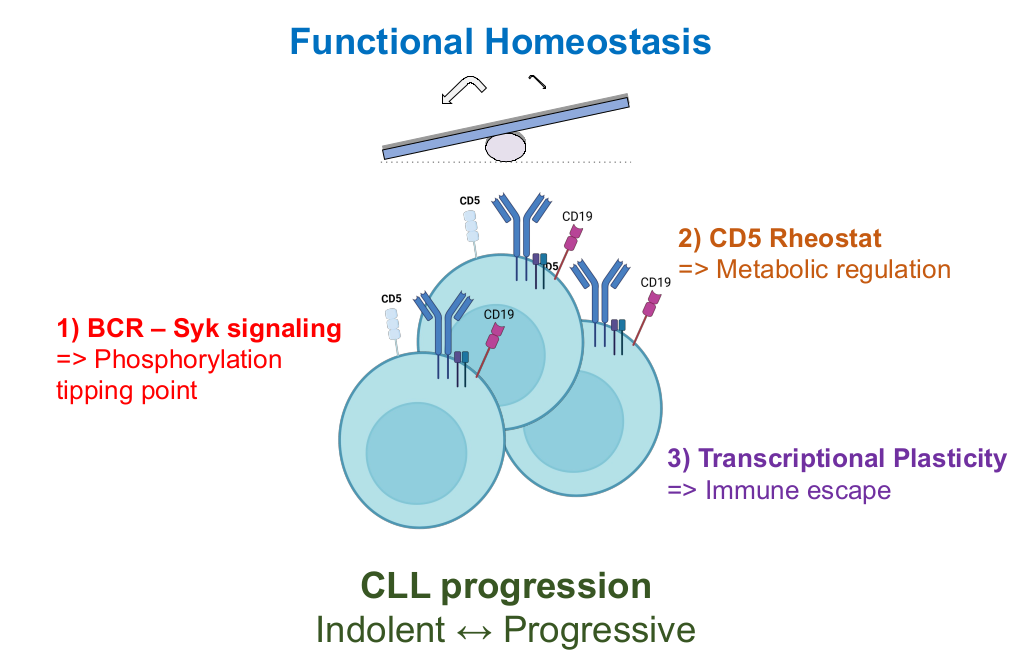
We investigate chronic lymphocytic leukemia (CLL), a highly heterogeneous disease in which clinical outcome remains difficult to predict despite established prognostic factors such as IGHV mutational status. Our work focuses on the intrinsic properties of tumor B cells, with a particular emphasis on the B-cell receptor (BCR) signalosome, to identify functional determinants of disease progression and new therapeutic vulnerabilities. We propose that CLL evolution is driven by disruptions in key cellular balances controlling survival, signaling intensity, tissue retention, and immune escape. To dissect these mechanisms, we are currently characterizing critical functional “tipping points” within tumor B cells that may separate indolent from progressive disease states.
We characterized novel genetic determinants involved in the heterogeneous progression of CLL and in resistance to treatment.
To identify new stratification markers, we developed a systematic analysis of the main genetic alterations at risk of progression. We characterized a hotspot mutation in IKZF3 gene encoding AIOLOS, a transcription factor essential to B cell development. The driving role of the mutation was demonstrated in a conditional knock-in mouse model, which develops a CLL-like oncogenic process with an altered transcriptional regulation of survival pathways. CLL patients carrying IKZF3 mutation or highly expressing AIOLOS showed similar transcriptional dysregulation and reduced sensitivity to inhibition of BCR signaling by ibrutinib (G Lazarian et al., Cancer Cell 2021).
With the “Clinical Research Centre” (CRC) and networks of clinicians, we have also described new mutations linked to resistance to treatment. These mutations are specifically detected on signaling effectors downstream of the BCR such as Btk or PLCg2 and appear in tumor cells to bypass the targeting of the pathway (ibrutinib and acalabrutinib; A Quinquenel et al., Blood 2019).
We described novel functional determinants of CLL tumor cells associated with disease progression. We characterized tumor cell subpopulations with regulatory properties involved in tumor tolerance. Accumulation of the regulatory tumor B cell population in untreated patients affects the T cell compartment present in the blood stream with a regulatory rather than an effector profile. The functional impact of the population is controlled by the levels of regulatory factors expressed. These include IL10 and TGFb1 initially described, as well as FOXP3, a transcription factor characterizing regulatory T cells. Analysis of two cohorts of patients associated the presence of the regulatory sub-population with anti-tumor immune dysfunction and disease progression (A Mékinian et al., Cancer Gene Therapy 2023).