
Topics 2 staff
 Laura Gardano
Associate Professor (MCF HDR USPN)
Laura Gardano
Associate Professor (MCF HDR USPN)
 Gregory Lazarian
Associate Professor (MCU-PH HDR)
Gregory Lazarian
Associate Professor (MCU-PH HDR)
 Fanny Baran-Marszak
Professor (PU-PH)
Fanny Baran-Marszak
Professor (PU-PH)
 Elisabetta Dondi
Research Engineer (IR USPN)
Elisabetta Dondi
Research Engineer (IR USPN)
 Mélanie Lambert
Associate Professor (MCF USPN)
Mélanie Lambert
Associate Professor (MCF USPN)
 Chuang Dong
Bioinformatics Scientist (IE INSERM)
Chuang Dong
Bioinformatics Scientist (IE INSERM)
Research
We characterized the molecular crosstalks responsible for a protective microenvironment and the formation of a tumor cell niche.
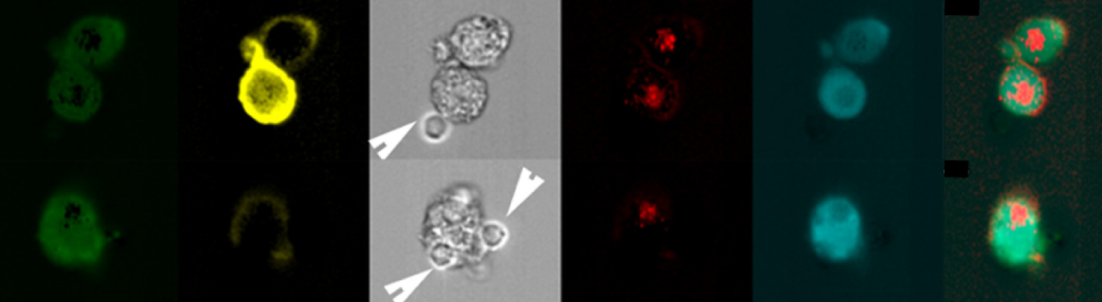
B cells from CLL or MCL infiltrate stromal cell lines or bone marrow-derived stromal cells in ex-vivo cultures, enhancing tumor survival. This protective role of the stromal layer is mediated by the stabilization of BCR signaling effectors in malignant B cells. In particular, we have demonstrated a dual role of stabilized b-catenin, at the plasma membrane by promoting adhesion to stromal cells and in the nucleus by inducing transcription of pro-survival factors such as IL6. Also, tumor cells promote metabolic changes in stromal cells, which in turn produce factors (Wnt16) that further activate B cells (G Lazarian et al., Oncogene 2020).
The tolerogenic tumor microenvironment contributes to the survival of chronic lymphocytic leukemia (CLL) cells by allowing their retention and nesting in lymphoid organs, particularly in lymph nodes (LN) where a proliferative pool is responsible for disease progression and contributes to resistance to current therapies. Bidirectional communication between tumor cells and microenvironmental cells promotes progressive evasion of immune surveillance.
We established a map of the lymph node microenvironment that confirmed the disorganization of CLL LN architecture and the identification of an infiltrating M2 macrophages population, called Nurse-like cells (NLCs), which appeared to be major players in the retention of CLL B cells. NLCs produce the chemokine CCL21which is retained on the membrane and captures CLL B cells expressing the CCR7 receptor. Inhibition of the CCL21/CCR7 interaction or the use of ibrutinib alters the adhesion of CLL B cells to protective NLCs. In contrast, ibrutinib does not affect CCL21 production by NLCs, suggesting the involvement of other molecules in this interaction R Zabboub et al. Blood Advances 2022).